
While it is true that Ferris Wheels are still in many amusement parks, they are not as exciting as they used to be. That is because the amusement park rides of today are designed to rattle your brains and scare you almost to death. Somehow, the simple movement of the Ferris Wheel seems quite tame. When Holden is grown, he will know that on a beautiful May afternoon, he and his grandfather rode the Ferris Wheel together. He will see that his grandfather’s arm was wrapped tightly around him and his grandfather’s big hand was firmly on his stomach. Sometimes the wheel stopped at the top. Holden didn’t mind. He felt safe. At first glance, this is just a photograph of two people on a Ferris Wheel. A closer look shows the generations, enjoying a symbol of the past. While grandchildren are small, they will be entertained by almost anything. The most important part of this photograph is that we come from somewhere. We eventually look like someone. We talk like someone. We look back on someone who loved us and feel right with the world. When this child’s life is going a million miles an hour, this keepsake photograph will remind him of a lazy, slow day in May where no one was in a hurry and he was the center of the universe.
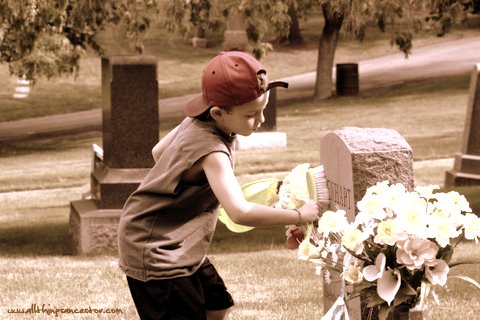
We took trimmers and brooms and cans for water. We cut flowers from the garden. We explained why we were here and what we were going to do. When we finished trimming and sweeping our ancestral graves, the grandchildren began to roam around. They found other grave stones to clean. Some had dirt. Some cobwebs. They took turns with the small broom. We could hear them sounding out the names. At first glance, it is just a photograph of a child sweeping a grave stone. But, it is much more. It is a child learning respect. Learning why we visit cemeteries and why we care for the graves of our ancestors. If we repeat this event throughout their young lives, perhaps they will visit us as we rest in a cemetery. Perhaps they will bring a broom and some trimmers for the grass. Perhaps they will help our great-grandchildren to sound out our names. So, you can see that visiting cemeteries with children is an investment. It is also a long-held respectful tradition. There aren’t many of them left.
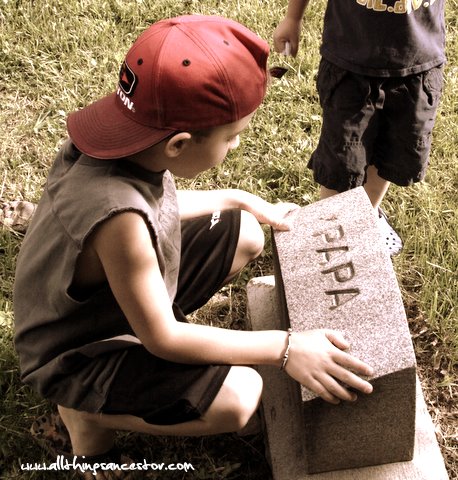
To the young child, just learning to read, the cemetery can be an interesting place. Aside from all of the unusual surnames, there are some words which are repeated over and over in a cemetery. They are mother, father, papa, mama, brother, sister, daughter, friend, wife, husband. Coming face-to-face with a stone with papa carved in it creates many questions in the mind of a child. Who is buried here? When did he die? Was he sick? Did he have a child like me? What does he look like under the ground? What will happen when he is resurrected? Will he be the same? Who made this stone? How did they carve the words? How long has it been here? What was the papa’s name?
At first glance, it seems like an ordinary photograph. But it is not. It is a child, learning about adult things and forming very good questions. If the questions are answered well, he will understand death better when he sees it and will know that death is just a passageway from one place to another. A passageway with a light left on.
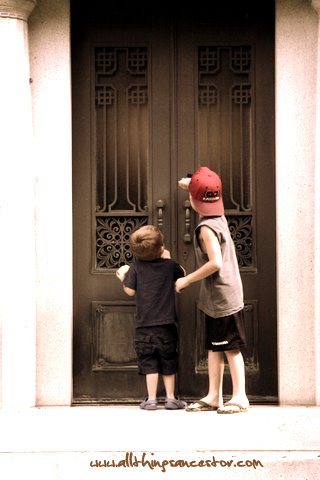
Cemeteries are strange places. Adults understand cemeteries but children are wary. On this Memorial Day we took Talmage and Holden with us to meet their ancestors. Well, at least to see their ancestors’ burial places. Walking through cemeteries gives grown-ups a chance to talk about things. About life and death. About beliefs. About why we are here on this earth and what will happen to us later on. The children wondered why anyone who was dead needed to be in a house with a door. They knocked on the door since that is what you do to a door, probably with racing hearts. Wondering. What if someone opened the door ?
This is a keepsake photograph to me. It captures an innocent moment where two little boys are trying to make sense of death and burial. At first glance, it seems like a photograph of two children and a very fancy door. But knowing where the door is found makes all the difference.
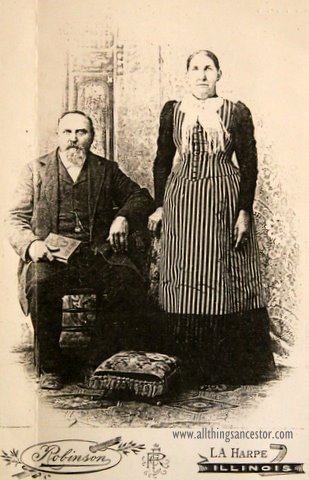
During our search for ancestral faces, we received a copy of this photograph which was taken in the 1800s. We hoped it was a photograph of ancestors Jerome and Mary Watrous from Terre Haute in Henderson County, Illinois. However, we have not been able to identify those in the photograph. Having never seen the face of Mary June Reynolds Watrous, we have nothing to help us with identification of her face except the face of her daughter Sarah Rebecca in old age. The comparison is not definitive. In the case of our ancestor Jerome Timothy Watrous, the only face we have for him is very blurry and was taken when he appears to be younger than this man. The beards are quite different and there is nothing else to help us identify this man. The original is on file at the Historical Society in LaHarpe, Hancock County, Illinois.
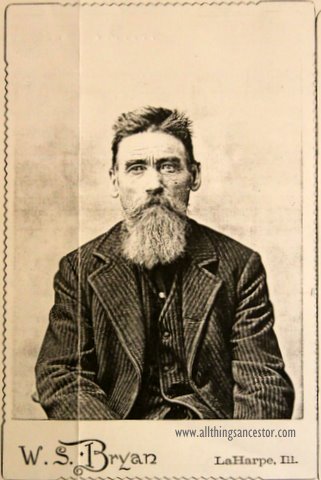
During our quest to find ancestral faces in the counties of Henderson and Hancock in Illinois, we received this copy of a photograph. We cannot match it to the face of our ancestor Jerome Timothy Watrous 1818-1904. It is on file at the Historical Society in LaHarpe, Hancock County, Illinois. I really don’t like faces without names . . .
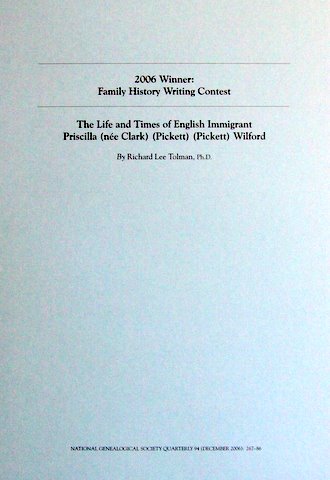
Priscilla Clark was born in England in 1826. In 1853, she married direct ancestor George Pickett after the death of his wife Maria Jarvis. George had three children at the time he married Priscilla. Daughter Jane Pickett is our direct ancestor. She married John Thompson Barker. Priscilla and George emigrated from England to America with others of their faith. They had heard the message of the missionaries of The Church of Jesus Christ of Latter-Day-Saints while in their native land and had been baptized. In 1857, they found themselves in St. Louis, Missouri, preparing to make the trek west to Utah. George Pickett contracted smallpox and died. Priscilla and the children continued on to Utah. In 1858, she married her deceased husband’s older brother William Armstrong Pickett. The marriage ended in the first year. Taking her daughter Maria Louisa from her marriage to George Pickett, and waiting for the birth of a child by William Pickett, Priscilla left Utah for California. By 1862, Priscilla married again. Her new husband was William Wilford. He was a wealthy man who lived in Carson City, Nevada. William and Priscilla had three children. When William Wilford unexpectedly died in January of 1869, he left his estate to Priscilla. Since he had been married before and had children with a previous wife, there was great contention among his posterity.
In June of the same year, Priscilla Clark Pickett Pickett Wilford was found dead in her home by her daughter Maria Louisa. She had been stabbed to death. Her daughter pulled the knife from her body.
Our ancestor Jane Pickett Barker was young when her mother Maria Jarvis died, when they made the voyage across the ocean and when her father died in Missouri on the way to Utah. Her own biographical notes state that she didn’t spend much time with her step-mother and did not know her half-sister Maria Louise very well.
Shown here is the cover of an excellent researched document written by Roger Tolman of Henderson, Nevada. A copy is in our personal family history file.
The migration of Priscilla Clark Pickett Pickett Wilford
England to Utah to California to Nevada
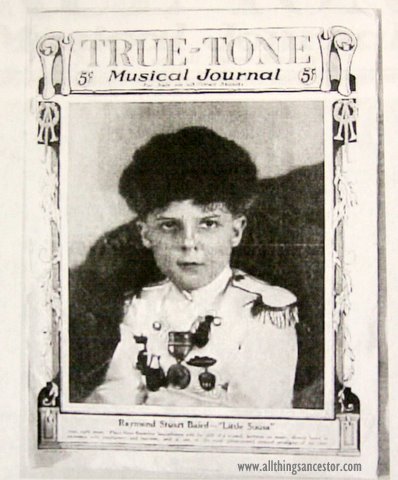
The story of little Raymond Baird, aka Little Sousa is very interesting. In his reminiscences, Everest Raymond Watrous recalled when his mother, Mary Maria Jenkins Watrous worked for Little Sousa. That statement prompted us to research Little Sousa. Raymond Baird is listed in the census of Salt Lake City, living with his mother and a younger brother. Around the age of six, this musical prodigy was invited to lead bands at the once thriving Saltair resort on the shores of The Great Salt Lake. Not only was he a band leader, he was a musician who played the saxaphone. He, his mother and brother are later found in the census of Los Angeles, California. There are many magazines such as this one which chronicled the life and talents of Raymond Baird.
Our ancestor Mary Maria Jenkins Watrous was a booking agent for him. Her son seemed to think that his mother traveled around the country with him but we cannot document that fact. Mary went to California where she lived with her son Mervin during the same time that Little Sousa and his family lived nearby. Perhaps Mary knew his mother while still in Utah or perhaps they met while in California.
When Raymond Baird grew to adulthood, he continued with his musical interests. He is listed as a musician in many Hollywood movies of the 1930s. As we tried to find records of his travels, hoping that we would find a reference to direct ancestor Mary Watrous, we found his son. His son had not seen any photographs of his father when Raymond was a child. It was satisfying to share this photograph with him. By the way, this magazine belonged to a man who had listed it for sale on ebay. When I contacted him and told him why I was interested in documenting if Little Sousa was indeed a real person, he copied this photograph and the contents of the article and mailed them to me without accepting any payment. Raymond Stuart Baird died in a New York City hotel room and is buried there. Today, his son works today in the carnival business. He tells us that he knew his father was a musician as an adult but knew nothing about his fame as a young child. When he looked at the photograph, he was astounded. He sent along by email, a photograph of his own son named Sam. Sam and his grandfather are most certainly kindred.
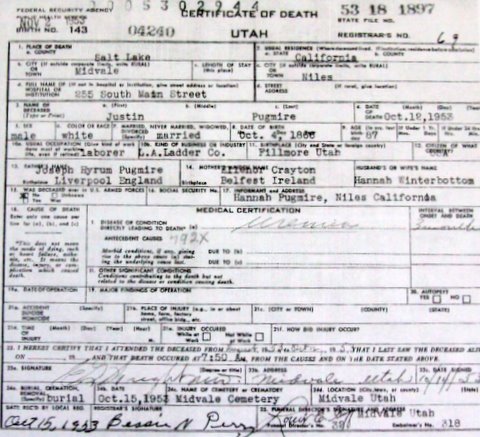
This is the death certificate for Justin Pugmire. He married Hannah Elizabeth Winterbottom. Their son Justin Gerald Pugmire is our direct ancestor. Justin had been ill for many years before his death. He was bed-ridden according to those who knew him. He died at the home of his daughter in Midvale, Salt Lake County, Utah.
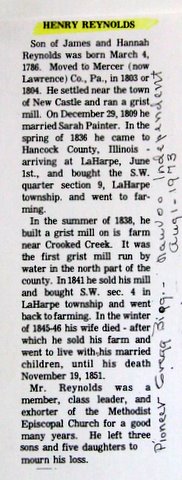
This is the obituary for direct ancestor Henry Reynolds which was carried in the Nauvoo Independent as a reprint in 1973. Henry married Sarah Painter. They became the parents of direct ancestor Mary June Reynolds who married Jerome Timothy Watrous. A summary of the life of Henry Reynolds is on this site.