
Juliet Pancake was born in Ohio to Samuel Crawford Pancake and Catharine Darling. She was the twelfth of thirteen children born to her parents. She was just fifteen when her parents left Illinois for Utah. In 1892, Juliet married Ralph Guthrie. They settled down in Utah where they lived their lives. Juliet and Ralph became the parents of one son named Boyd Leslie Guthrie.
Juliet was active in the Women’s Republican Club of Utah and in the Salt Lake Literary Club. By 1892, three years after her marriage to Ralph Guthrie, all of her large family had left Utah for other places. Upon a visit to Colorado, Juliet died. Her body was brought back to Utah by train in the company of her son Boyd. Her funeral was conducted by the Evans and Early Mortuary. The pastor of The First Presbyterian Church officiated at a service for her. The mortuary staff served as pallbearers. The pastor charged a $10 fee. The mortuary charged $75 for embalming. Ethel played the organ. Juliet had one niece still in Utah. She had actually been named for Juliet and was the daughter of Juliet’s sister Carrie Virginia Pancake Conwell Drage. She was Juliett Galena Conwell Giesy. Perhaps Galena attended the service.
Juliet was buried in the family plot purchased by her father in 1883 for $40. She joined her sister Demie Seville Pancake Whitely, her father Samuel Pancake, her brother Marion Pancake, her husband Ralph Guthrie, her nephew Martin Watrous and would later be joined by her son Boyd Guthrie, her niece Juliet Galena Conwell Giesy and Galena’s husband John U. Giesy.
The descendants of Juliet’s sister Glendora all lived in Salt Lake City. At the time of Juliet’s death her sister Glendora’s posterity consisted of two sons; one living named Everest Elliott Watrous who was Juliet’s first cousin and one deceased named Earl Pancake Watous. Everest had three sons and Earl a daughter and a son. If they knew about Juliet, they didn’t say. It seems that no one spoke of anyone in this family. It wasn’t until the year 2000 that we met Juliet Pancake Guthrie.
The migration of Juliet Pancake Guthrie
Ohio to Illinois to Utah
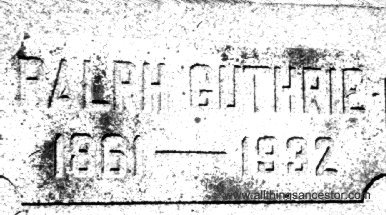
Ralph Guthrie was born in Ohio and died in Utah. He married Juliet Pancake in Salt Lake City in 1892. Juliet and our direct ancestor Edith Glendora Pancake Watrous were sisters. When Ralph and Juliet were first married, he was listed as a stockbroker. In 1901, Ralph and Juliet became the parents of a son whom they named Boyd Leslie Guthrie. For many years, Ralph was the Salt Lake City Postmaster during both the Harding and Coolidge Administrations. He died before his wife, who lived to be 92 and was buried in the Samuel Pancake Family Plot in the Mt. Olivet Cemetery in Salt Lake City, Utah. His wife Juliet and his son Boyd later joined him in the same plot.
The migration of Ralph Guthrie
Ohio to Utah
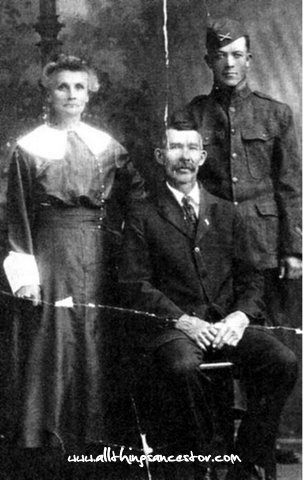
Joseph Albert Pugmire was born to direct ancestors Justin Pugmire and Hannah Elizabeth Winterbottom. He was the third child of thirteen born to his parents. The oldest child was direct ancestor Justin Gerald Pugmire. Joseph was born in Fish Haven, Idaho and died in California. He served in World War I. This portrait was taken before he left for an overseas tour of duty. In 1922, he married Mary Eva Miller. They became the parents of three children. Throughout his life, Joseph Albert was primarily a plumber and a carpenter. In 1930, the census shows him living with his family in Echo Canyon, in Utah. He is employed in the building of the dam which today holds back the Echo Reservoir.
While he died in California, his burial was in the Midvale City Cemetery in Midvale, Salt Lake County, Utah. He and his brother Justin Gerald died the same year at ages 57 and 53.
The migration of Joseph Albert Pugmire
Idaho to Utah to California to Utah
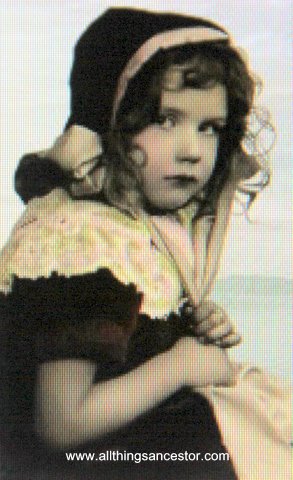
Lydia is such a pretty name. In fact we have a granddaughter named Lydia. The same age as Lydia Viola was when she died of cholera at the age of four. Lydia was the oldest child of Jerome Timothy and Mary June Reynolds Watrous. She was born in the tiny farming community of Terre Haute in Henderson County, Illinois. Her home was just a few miles from LaHarpe. Her younger brother Henry was born not long after her. Henry is our direct ancestor. Her sister Sarah Rebecca was born a year before she died. It is hard to imagine the anguish of the death of a child. Cholera was a killer then and still is in much of the world where the cleanliness of water cannot be guaranteed.
Lydia Viola Watrous was buried in the Painter Family Cemetery. She joined her grandparents Henry Reynolds and Sarah Painter. Her mother joined her in 1893 and her father Jerome in 1904. The remains of Lydia Viola, her parents, her grandparents and numerous extended family members were moved to The Terre Haute City Cemetery sometime after 1904. She rests between her parents and near her grandparents. Their graves are marked with a large stone which reads Reynolds/Watrous. Each person has a small marker with a name and two dates.
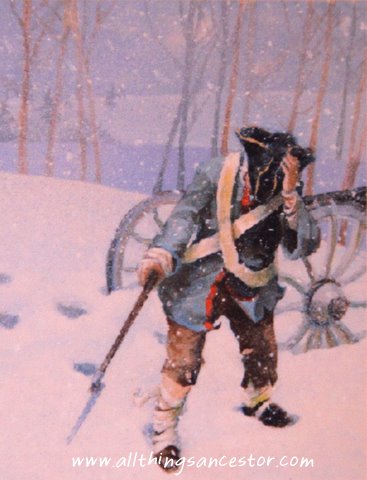
Direct ancestor William Painter was possibly born in New Jersey and died in Pennsylvania. From 1780 through 1783, William served in the Revolutionary War. He served in the company of Capt. William Smith, 6th Battalion, Chester County Militia. After he returned from three years of service, he married Martha Torton in 1784 in the Second Presbyterian Church in Philadelphia, Pennsylvania. William’s wife Martha was, however, a Quaker. William and Martha became the parents of nine children. Three of their children married three of the children of James Reynolds and his wife Hannah Webster. They were Sarah, their second child, who is our direct ancestor through her marriage to Henry Reynolds; William who married Hannah Reynolds and Martha who married John Reynolds. Many of William’s children left Pennsylvania when they married. Many stayed together in Illinois.
William Painter died in Chester County, Pennsylvania. The Sons of the American Revolution placed a marker on his grave which reads:
William Painter – Smith’s Company – 6th and 4th Batt PA MIL – Revolutionary War – Oct 9 1760-Dec 28 1842
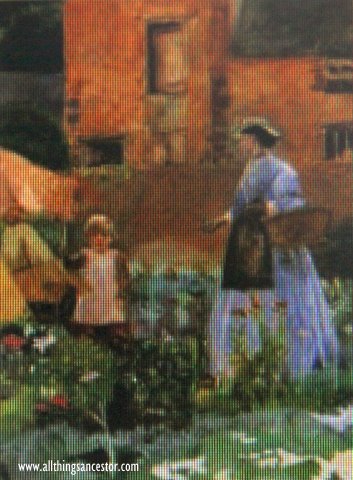
Mary June Reynolds was born in Pennsylvania to Henry Reynolds and Sarah Painter. She was the seventh of eleven children born to her parents. Her father Henry was a Quaker. He baptized his daughter Mary June. Her mother was an Episcopalian. When she was still young, her parents migrated from Pennsylvania to Illinois and settled near LaHarpe. It appears that Henry Reynolds did not strictly adhere to his Quaker beliefs. The children may have more closely followed their mother’s beliefs. Her father operated a grist mill and farmed the land. Mary was said to be a self-educated woman who was well read. At the age of fifteen, she began teaching in what was called The Prairie School.
In 1844, Mary married direct ancestor Jerome Timothy Watrous. He had migrated in the company of others from Ohio to Illinois. His young wife died soon after arriving, leaving him with a young daughter to care for. The daughter’s name was Caroline Malone Watrous. Jerome and Mary became the parents of three children and the parents of an adopted daughter. Their first child was Lydia who died of cholera at the age of four. The second was direct ancestor Henry Reynolds Watrous. The third was Sarah Rebecca Watrous Gittings. They also adopted a “soldier’s orphan” named Mary Ellen Byrnes at the age of ten. They raised her as their own and gave her every opportunity for education and enrichment as they gave their natural children.
They lived on a farm in the tiny farming community of Terre Haute in Henderson County, Illinois until the year of 1879. Jerome’s daughter Caroline married Martin Schillinger and moved to Moline, Illinois in Rock Island County. Henry went away to school and became an attorney. In 1879, Jerome and Mary Watrous sold their farm to C.R. Gittings who would later become the husband of their daughter Sarah Rebecca. Jerome, Mary and their daughters moved along with their son Henry and his wife to Red Oak, Iowa in Montgomery County. This was the place of Henry’s first job as an attorney. They stayed in Red Oak for six years. Their daughters Sarah Rebecca and Mary Ellen Byrnes went on to Oberlin, Kansas where they attended school. Henry and his family moved on to Utah. Jerome and Mary went from Iowa to Hastings, Nebraska for three years and then to Oberlin, Kansas for one year. Then, they returned to their home town of Terre Haute, in Henderson County, Illinois.
Mary’s daughter Sarah Rebecca married Clarence Roland Gittings in St. Louis, Missouri. Sarah and Clarence returned to Terre Haute and built a new home on the property Clarence had bought from his new wife’s father years before. Mary Ellen returned home to be married to Joseph Longfellow Hoover in her sister Sarah Rebecca’s new home in 1891. When Jerome and Mary returned to Terre Haute, they found that their two grandsons were coming to visit them. Everest and Earl Watrous were the sons of their son Henry. Henry and his wife Glendora Pancake had divorced in Utah. The visit of two boys with their grandparents lasted two years. It was only when Mary was too ill to care for them, that they were put on a train and returned to their parents in Utah.
Mary was known as a kind and charitable person. Those who knew her said that she was always caring for someone in her home. During her lifetime, she cared for her husband’s daughter Caroline, her adopted daughter Mary Ellen, her own children Lydia, Henry and Rebecca, her brother and nieces. In her illness, she was cared for my her daughter Rebecca in her daughter’s home. The home which was built on the same property where Mary’s home had once stood.
When Mary June Reynolds Watrous died, her funeral was held in the home of her daughter Sarah Rebecca Watrous Gittings. She was buried in the Painter Cemetery but was later moved to The Terre Haute City Cemetery along with her husband, daughter, parents and other members of the Painter-related families. Her obituary tells us that she was a student of the Bible and read it many times. She was a fine teacher and a woman who brought refinement and education to her home and her family. We long to see the face of Mary June Reynolds Watrous but still look for it. We know that she had her portrait taken, but once it left the hands of her daughter Rebecca, it disappeared . . . for now.
The migration of Mary June Reynolds Watrous
Pennsylvania to Illinois to Iowa to Nebraska to Kansas to Illinois
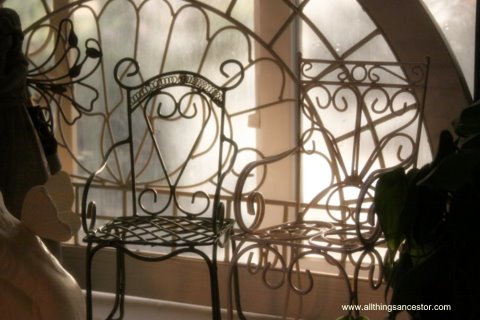
My friend has a wonderful display of small chairs. It sits on top of her kitchen cabinets. I asked her about the chairs and she told me that one was hers when she was a little child and the rest had sentimental significance. She had collected them through the years. Leaning against the wooden chairs was a piece of glass in an old and weathered frame. In cursive on the glass was the phrase “no empty chairs in our heavenly home”. No matter where you sit in her house . . . in the kitchen or the family room or if you just walk down the hallway . . . you are reminded that we hope for a reunion with those we love when we go home.
These are my chairs. I am not sentimental about them but I do love them. As I struggle to find those who are lost for now, a glance at the chairs keeps me focused and reminds me why I am still looking. Still rummaging through virtual boxes and files in a million databases from the same number of places and people. I can visualize our family in the next life, gathered around the table, talking about our experiences in life. All of us. I can also imagine how lonely I would feel if I looked around the table and couldn’t find a child . . . a grandmother . . . a sister. What if all that I could find was an empty chair?
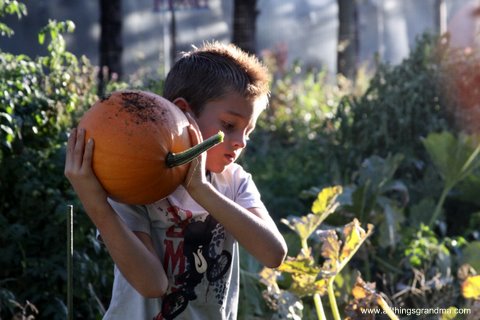
From the journals I have read, I know that my ancestors prayed over their fields, crops and gardens. Having an abundance of food to put away for the winter often meant the difference between life and death. If their crops failed, if the wind blew the fruit from their trees too soon, if pests ate their beans and peas . . . they couldn’t replace what they lost until the next season. I can go to the store. One of my heroines, Patty Bartlett Sessions, sat on her porch most days in September and October guarding her orchards with a shotgun. Every peach and apple was like gold to her. Not only did our ancestors dry fruit and jerk meat and store potatoes and onions in root cellars, they joined a sophisticated culture of barter where their crops and skills could be traded for something they needed but didn’t have.
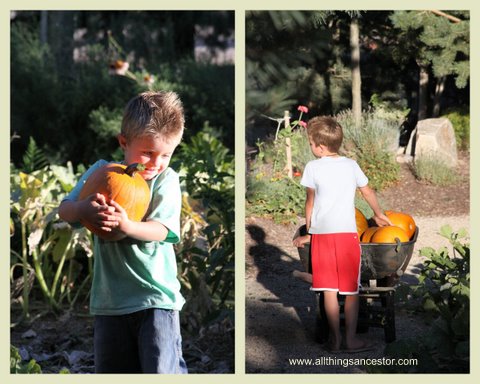
Many of our pumpkins are already orange. Even though we planted them later this season, they ripened sooner than we wanted them to. We decided to harvest the orange pumpkins and store them in a cool place at least until October. Whether they make it or not we’ll just have to see. So much of the fun of the harvest for the boys is using Grandpa’s pumpkin knife. Ordinarily a boy wouldn’t be able to find it if he tried. Grandpa hides things. But, Grandpa watched while the boys cut the pumpkins from their vines.
We are not counting on the pumpkins for our winter food. We are going to make jack-o-lanterns out of most of them. Our ancestors prayed over their gardens. They prayed over pumpkins, beans, peas, potatoes, onions and every other food, fruit or crop that had been planted and needed to be harvested before the snows came. They prayed over animals and weather and those who were ill. Understanding the anxiety our ancestors must have felt when the winds came or the snow fell or the insects swarmed helps me to understand why they lived so close to their faith and why it is good for our souls to plant a garden.

You may think that this is just an ordinary painting. I will tell you why it is not. This painting hung in my husband’s family home for as long as he could remember. It was a pale but beautiful watercolor of a woman’s head. It wasn’t any particular woman, at least not as far as we knew. It was signed by Stella Gilcrest and was painted in 1918. In the year 2004, we found The Last Will and Testament for Edith Glendora Pancake Watrous. She is our direct ancestor. She left Utah for Kansas, where she spent the last twenty-five years of her life. She left her two sons behind with her former husband Henry Reynolds Watrous. In her Will, she told us that she wanted my husband’s grandfather, Everest Elliott Watrous to have one of her prized paintings . . . the watercolor of the woman’s head. The woman’s head.
Suddenly the painting, which had hung on the walls of more than one home for years and years took on new meaning. It wasn’t just a painting. It was Glendora’s painting. It was originally on the walls of her son Everest’s home. When he died it hung on the walls of Everest’s son’s home. When Everest’s son Raymond and his wife died, it came into the hands of Glendora’s great-grandson. It is now in our home.
We wrapped it carefully and began the search for the artist. It turns out that she lived in Wellington, Kansas at the same time as our ancestor Glendora. So, we knew it was a painting with some connection between person and place. It was a personal painting of some kind. That is all we know. Stella died. If she had posterity we can’t find it. Someone sat for the portrait but it couldn’t have been Glendora. Glendora was almost sixty when it was painted. Maybe it was painted from a photograph. Maybe it is a young Glendora. Maybe.
This portrait of the woman’s head reminds us that there may be special keepsakes all around us. Perhaps they are just old familiar things. Perhaps no one remembers where they came from. Sometimes they just look like old things. Worn-out things. Be careful.

If you are old enough you will remember letters. Letters were thoughts on paper which a person wrote by hand. Sometimes a letter took some time to write because one had to think. Usually a person put a date on a letter which helped the recipient to know when it was written and how long it took the Postman to deliver it. The Postman used to sort his mail at the post office and pack it in a big, leather bag. Then, he would walk around the neighborhood, putting letters like this one into mailboxes which were usually on each person’s house. Some people had little slots in their front doors for mail. The Postman would slip the mail through the slot and it would land on the floor.
People usually chose their words carefully when they wrote letters because people kept letters. It also cost a nickle or so to buy a stamp to mail the letter. The cost was determined by the weight and where the letter was going. That is why people used to write letters on thin paper called “onionskin” because it was light weight.
This letter tells the reader many things. Beyond the words are many other clues to the writer and the time. An older person wrote this letter because the handwriting is a little shaky. This grandmother wanted to know how her grandson was doing at his Army summer camp. Since he was her granddaughter’s husband, it reveals the regard this grandmother had for all of her family . . . natural or not. She talks about the weather and the beautiful parade she had watched in the morning. She closes with a wish for his health and safety and signs the letter in a way that all of her family came to love.
Letters are keepsakes. They stop time in place. They help us to recall certain events and of course, certain people.
The reason why I chose to put a letter in All Things Ancestor is because few people write letters anymore. They text and send email. If they write a letter, they do it on the computer because it is faster. It is a romantic notion from the past to sit at a table, dip a pen into an inkwell and write a long letter. If you get a letter . . . save it.