
Mathew Morris was the youngest child of seven born to his parents Joseph Morris and Elizabeth Vernon. His brother George Morris is our direct ancestor through George’ wife Hannah Maria Newberry Morris. He was born in England and died in Utah.
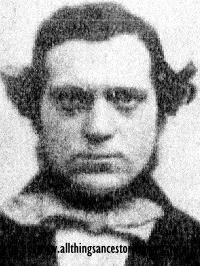
Joseph Morris was the fifth child of seven born to his parents Joseph Morris and Elizabeth Vernon. We know him as the brother of our direct ancestor George Morris and as the leader of the apostate church called the Morrisites. Joseph was born in England. He worked in the mines and is said to have suffered a concussion or two which left him a bit strange. His brother George tells us in his journal that his brother became quite excited about religion after his accidents.
At the age of twenty-three he heard the message of the missionaries of The Church of Jesus Christ of Latter-Day-Saints and was baptized along with other members of his family. He married Mary Thorpe and together they came to America. They first lived in St. Louis for two years and then in Pennsylvania before making the trek to Utah where they finally settled in Weber County. Joseph began to claim spiritual manifestations and spoke out openly against the Prophet Brigham Young. He began recording his “revelations” in 1857 which included the day that Christ was coming back to earth. He was able to draw many members of the Church to him. He considered himself to be a Prophet.
When some members of his group decided to leave and take their property with them, Joseph and others detained and imprisoned the men. When word came to the District Judge, officers were sent to free the men and arrest Joseph Morris. When all was said and done, Joseph and some followers resisted and were killed. He was thirty-eight. Direct ancestor George Morris writes in his journal that the authorities came to his home to see if he wanted his brother’s body to bury. George reportedly said that they had killed him and they could bury him.
There are many references to the unstable nature of Joseph’s mind. I think that may be clear by looking at his portrait. Those who had affiliated with him in his personal church scattered to neighboring states and mixed in with the local populations.
The migration of Joseph Morris
England to Missouri to Pennsylvania to Utah
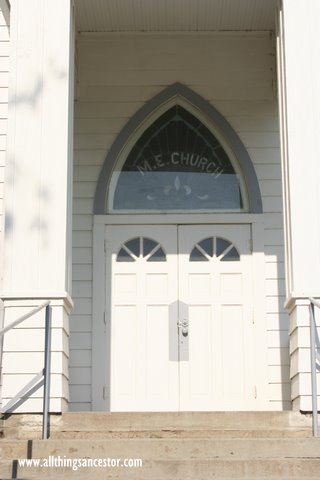
When all was said and done, we found much information about our ancestor Jerome Timothy Watrous, his wife Mary June Reynolds and their children Henry, Sarah Rebecca and adopted daughter Mary Ellen Byrnes. The one piece of their later life migration that has eluded us in a reference in Jerome’s obituary to a few years in Hastings, Nebraska. Since we have found nothing to put them in Hastings, Nebraska, we began to wonder the day we visited Red Oak, Iowa. We knew that Jerome and his wife, along with their two unmarried daughters, joined their son Henry Reynolds Watrous and his wife in the town of Red Oak, Iowa. Henry had secured his first job as an attorney. The whole family went along. After three years, Henry and his wife Glendora and their two living sons, determined to move on to Utah where Glendora’s large family now lived. They were involved in the mining business, both as miners and investors. When Henry left Iowa for Utah, his parents went somewhere else before returning to their home of Terre Haute in Henderson County, Illinois. So, when we had visited Red Oak and photographed the place . . . including the Evergreen Cemetery where a little son was laid to rest, we came to the next town. It was Hastings, Iowa. While we didn’t think that Sarah Rebecca Watrous Gittings would make a mistake about something like Hastings in the wrong state, it was hard to miss the fact that it would have been easy to move on down the road rather than across a state.
Then, another person with ties to this family told us that the time Jerome and Mary Watrous spent in Hastings, before they returned to Terre Haute, was connected to their church. The clues were piling up but the conclusions were not forming. We drove into town. It was a beautiful Iowa town. There were no sidewalks. In front of a home were two people in chairs. We stopped the car and got out. They were so gracious. We told them that we wondered if our ancestors had come to their town of Hastings after leaving Red Oak rather than going to Hastings, Nebraska. We told them that in Illinois, Jerome and Mary had affiliated with the Methodist Church. There, across the street from us was the Hastings Methodist Episcopal Church.
There was such kindness from these strangers. The woman took down our names and address. She said that in the morning, when someone was at the church, she would search the records for us to see if our ancestors had been there. We could tell that these strangers, who had pulled up two chairs for us, didn’t want us to go. They found the conversation interesting. It gave them a chance to talk about their town and nearby Red Oak. It was a wonderful hour.
Not long after we got home, a letter arrived from Hastings, Iowa. She was sorry to say that the records of the church did not include our ancestors. That doesn’t mean they weren’t there but they weren’t recorded. Perhaps because they belonged to their congregation in Terre Haute, they did not want to be on the list for a different congregation. Or, we had just gone on a wild goose chase. Either way, the experience was a repeat of many experiences like it. Complete strangers reaching out. Offering to help. Trying to figure things out. The process of putting together a family history would be very difficult if there weren’t angels along the way who are willing to pull up chairs for strangers and go the extra mile.
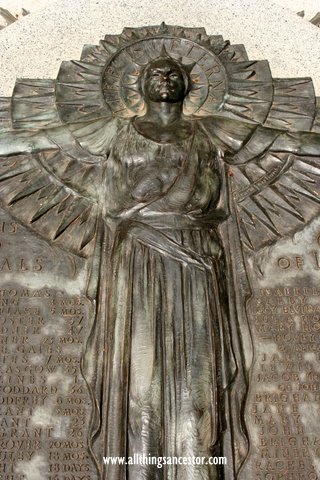
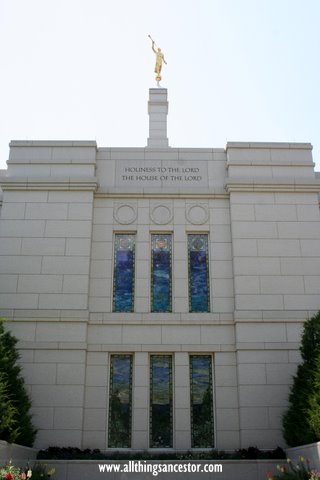
Few events were as monumental in the lives of many of our ancestors as the encampment at Winter Quarters in what is today Florence, Nebraska. Many of our ancestors have recorded their experiences in their journals which include the cold, hardships, hunger and fear that followed them from their comfortable homes in Nauvoo, Illinois. Many stayed at Winter Quarters for many months as the name of the place implies. Several ancestors died there during that awful winter and are buried in the graveyard or in the countryside round about. Recently, a Temple of The Church of Jesus Christ of Latter-Day-Saints was built on the hill next to the graveyard where many, many Saints rest. This angel signifies the holiness of the place and the reverence many feel for the ancestors who sacrificed so much to worship without persecution. Not all people who died as a result of their months at Winter Quarters are buried there. Some died on the trek from Nauvoo and outlying towns to Winter Quarters. Others died as left the place behind and made it only miles into the plains. When we think of our early pioneer ancestors, we think of many in the context of the hardships of Winter Quarters in 1847-1848.
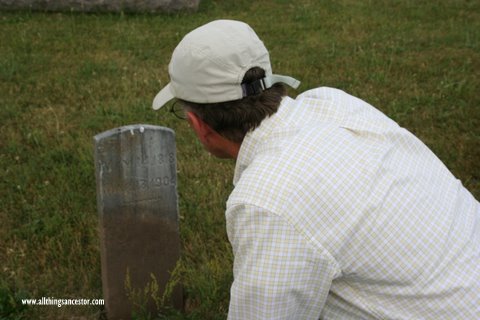
This is the original grave stone for Jerome Timothy Watrous who was born in 1818 in Ohio and died in 1904 in Illinois. It was originally placed in a straight row with similar stones for his wife Mary June Reynolds Watrous and little daughter Lydia Viola who died at the age of four. We we first visited the Terre Haute City Cemetery on the main road through Terre Haute on the way to LaHarpe, the stones were weathered and had sunk into the ground at odd angles. Although a very large stone had been placed which contained the surnames of Reynolds and Watrous, the small stones marked the actual graves of the ancestors. Each stone was long and slipped well into the ground. Only about one fifth of the stone was visible above the ground. That is where the information was carved.
We drove a mile down the road and stopped at the home of a connected relative whom we had never met. He was of the Painter family. We introduced ourselves and talked awhile. We asked it we could borrow a shovel to re-set the gravestones. He asked that we let him and his son do it for us. Not too much time passed before we received a letter with photographs of the re-set stones. It was a wonderful act of kindness by strangers. We are grateful. We remain the first and only members of our family of any generation except that which buried them, to know where they are resting and to see the place for ourselves.
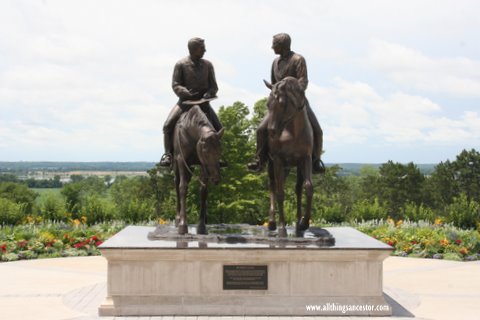
Many of our ancestors lived through the events in the early Church including the trials and tribulations which befell the Saints in Nauvoo, Illinois. Many journals, including that of George Morris and Jonathan Pugmire talk of their direct contact with the Prophet Joseph Smith and his brother, the Patriarch, Hyrum Smith. Other journals from the time that we have read have referred to various relationships with the Prophet Joseph Smith. All of our ancestors who received Patriarchal Blessings while in Nauvoo, did so by the hands of Hyrum Smith. Hezikiah Sprague was one such ancestor. Therefore, these two men played a significant role in the lives and destinies of our ancestors. This beautiful statue of Joseph and Hyrum riding off to Carthage is a touching reminder of the events of that time. They were murdered in the jail at Carthage and would not return to their beautiful city again in this life. Beyond them is the great Mississippi River which also played a part in the history of The Church of Jesus Christ of Latter-Day-Saints as our ancestors moved across its frozen surface as they were driven from their homes by the mobs. In front of Joseph and Hyrum, also overlooking the giant Mississippi is the re-built Nauvoo Temple. It is impossible to have an understanding of many of our ancestors without knowing the history of the Church and the events that took place in their in the lives of Joseph and Hyrum Smith. Many of those dramatic events were witnessed and shared in by our ancestors.

Among the inspiring stories surrounding our ancestors is the story of John Painter Reynolds. He was the youngest child of eleven born to his parents Henry Reynolds and Sarah Painter. He came to Illinois from his birthplace in Pennsylvania in 1836. His father Henry bought a farm two miles north of LaHarpe. After the death of his parents, John lived with our direct ancestors Jerome Timothy and Mary June Reynolds Watrous. Mary and John were siblings. He lived with them in the tiny farming community of Terre Haute at the time that our ancestor Henry Reynolds Watrous was growing up and also lived there to become well acquainted with his niece Sarah Rebecca Watrous.
In 1862 he enlisted in the Union Army and served well until his discharge in 1865. He returned to Terre Haute and lived once again with his sister, direct ancestor Mary June Reynolds Watrous. In 1873 he married Henrietta Tidball in Davenport, Iowa. They lived in Illinois until 1875 when he sold his farm and moved to Iowa. There he became affiliated with the Methodist Episcopal Church. From Iowa they went to Nebraska and from there to South Dakota. John and Henrietta became the parents of two children. Marie and Verne.
John received word that his beloved sister Rebecca Reynolds Genung was very ill. He traveled to her in Terre Haute, Henderson County, Illinois and faithfully cared for her by her bedside for many days. When she died, John had become ill himself and could not attend her funeral. It had only been weeks before that his own wife had died, leaving him a widower with two, young children. Nine days after his sister’s death, John died also. Prior to his death, he had been cared for by his niece, Sarah Rebecca Watrous Gittings who became a person who cared for many people in their last days. Sarah Rebecca had cared for her mother in her home until Mary’s death. She had cared for her husband in her home until his death. She cared for her father Jerome in her home until his death.
John Painter Reynolds was laid to rest in the Terre Haute City Cemetery in the county of Henderson in Illinois. We assume that other family members cared for his two children but do not know.
The migration of John Painter Reynolds
Pennsylvania to Illinois to Iowa to Nebraska to South Dakota to Illinois
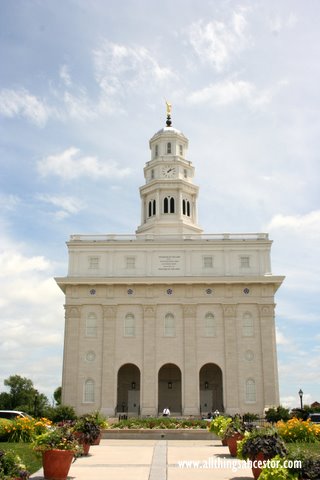
The events which took place in and around Nauvoo, Hancock County, Illinois are laced through the lives of many of our ancestors. Many were converted to The Church of Jesus Christ of Latter-Day-Saints in their native lands of Europe and in their towns and cities across New England and in other parts of America. They were driven by a “spirit of gathering” which caused them to gather with others of their faith. For seven years, they enjoyed the peace of Commerce, Illinois which was re-named Nauvoo. It sat on the banks of the Mississippi River and was re-claimed from its swampy condition to become a beautiful city. Our ancestors helped to build the original temple in Nauvoo. They sacrificed to buy the materials and donated their time and labor until it was complete enough for parts of it to be dedicated and used. Then, they guarded it with their guns and lives as long as possible before fleeing Nauvoo for points west. They were hardly on their way before the mobs desecrated the Temple and burned it. In the 21st century it was rebuilt with the tithing dollars of faithful members of the same Church which had been driven from Nauvoo in the middle 1800s. It is a replica of the original and as true to the original building as could be built. Six thousand Saints received instruction in the Temple before they fled. Among them were many of our direct ancestors including those with the surnames of Pugmire, Morris and Sprague.
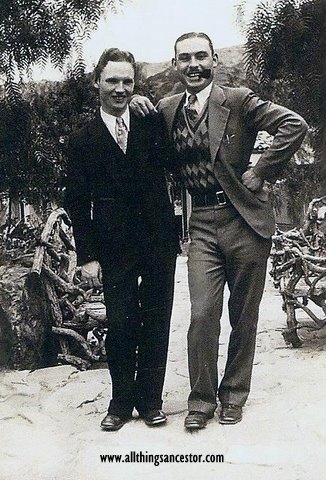
This keepsake photograph is of Mervin Reynolds Watrous, born 1903 on the right and his brother Wayne Elliott Watrous, born 1905 on the left. They were the two oldest sons of Everest Elliott Watrous and his wife Mary Maria Jenkins. Their younger brother Everest Raymond, born 1909 is our direct ancestor.
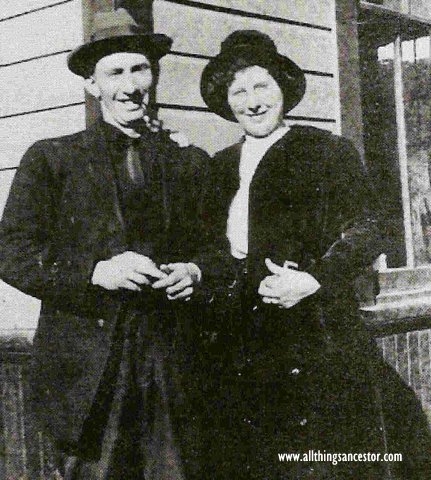
This keepsake photograph is of Everest Elliott Watrous and his wife Mary Maria Jenkins. They were married in 1902 when he was nineteen and she sixteen. This photograph was most likely taken in about 1915 in either Salt Lake City or Park City, Utah.