Missouri Persecutions by B.H. Roberts: Original Copy
2011
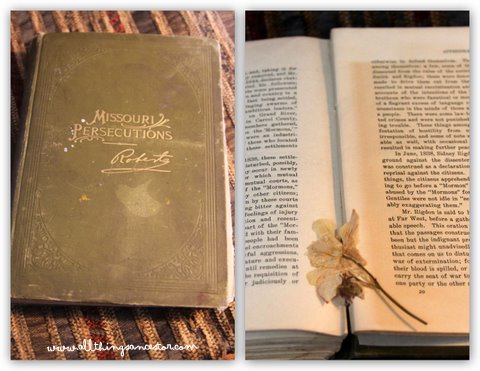
I thought that I had read every book on our bookshelves and some books more than once. As I put one book away, an old and worn book caught my attention. I reached in and brought it out. It was an old book and looked like it had been read and handled. It had a cover with raised designs and a title filled with gold-looking ink. The spine was weak and when I opened the book, I found that the Title Page, the Introduction and Table of Contents were all missing. The first page began with Chapter One.
I carried the book to a comfortable chair and started the read.
As a member of The Church of Jesus Christ of Latter-Day-Saints, I knew a great deal in general terms about the suffering of the early saints in many places. Not until I read this account did I fully understand these years from 1830-1839. I knew of B. H. Roberts whose full name was Brigham Henry Roberts, but I didn’t know anything at all about him other than I thought he was a Church Historian. I looked up information about him and found that he wrote this book in 1900. He was a fair-weather member of his faith until later in his life. He traveled from England as a young child by himself and walked the plains to meet his mother who was already in Utah. After 1888 he became a General Authority in The Church of Jesus Christ of Latter-Day-Saints and served in the First Quorum of Seventy. He was known throughout the rest of his life as a “churchman”, served many missions and served as an assistant Church Historian.
I was drawn into the story of these years and these events almost in the first word. His style reminded me of reading Charles Dickens or Nathaniel Hawthorne. When I have read either of these authors, I have had to take big breaths to be able to get through their long sentences . . . punctuated by a million commas. He has a beautiful style and a way with words. I think he used poetic license on more than one occasion because I am not sure how he could have known what he said he knew. But, he used journals. He talked to people who were still alive who had experienced the persecutions themselves. He researched only twenty or so years after the final chapter.
We have ancestors in our records who joined the people who sought redress for their losses from the State of Missouri and from the Federal Government. They became parties to the Missouri Redress Petition. We have ancestors who were driven from their homes in the dead of night in the snow and cold, who watched their homes burned to the ground with all of their possessions and who fled with their little children for their lives.
As I turned the pages, I marveled at the sacrifices my ancestors made for their beliefs. It seemed that even death did not deter them from gathering together to share the company of those who believed as they did. Then, I turned a page and out fell a columbine. It was flat and dry. It was a perfect bloom. Neither of us know where the book came from. We don’t know who it originally belonged to or how we came to have possession of it. As I read on, I stopped to share what I was reading. Some things were so profound. Some things so inhumane. I wondered how people could do what they did. Who were these people? The persecutors.
Every twenty pages or so, I came across another columbine blossom. Neatly pressed and perfectly preserved. I really do wonder who picked the blossoms and pressed them in the book. Who bought the book and what happened to the first few pages. How many hands handled it and where it had been in its journey. Perhaps it is a re-print but I don’t think so. It has all the earmarks of an early edition.
I finished the book with tears in my eyes and gratitude for the sacrifices of my ancestors. I would like to thank them someday.
2 comments
Trackback e pingback
No trackback or pingback available for this article