A Life Full of Riches
I am not related to Mr. Green. But Mr. Green spoke for me and many others when he expressed his feelings about material versus spiritual wealth. He wrote his essay for Newsweek Magazine in 2007. I cut it out and made copies for my children. As his comments relate to the gathering of family history, I have learned from ancestral records that our ancestors were content and felt rich as long as their needs were met for food, shelter, clothing and God. Their attitudes more closely mirror Mr. Green’s attitudes than do those of most people alive today. A full reading of Mr. Green’s essay is available in the Newsweek Archives under myturn.Newsweek.com.
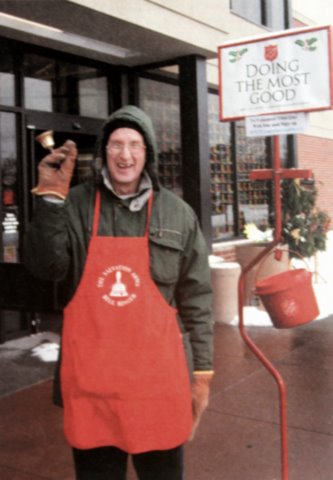
Here are my favorite excerpts:
“It was early December 2003, my first season as a Salvation Army bell ringer, when I was confronted with the question. A neatly dressed woman and her young son walked up to the kettle stand. While she searched her purse for some cash, the boy looked up at me. I can still see the confusion and curiosity in his face. “Are you poor?”
“Well,” I stammered, trying to think. “I have more than some people, but not as much as others.” His mother scolded him for the social no-no, and they hurried off to do their shopping. His question, however, did not leave me.
I’ve never thought of myself as poor, but I can’t deny certain facts. Every time I fill out my 1040 form, I fall into one of the lowest income brackets. In the past 35 years, I’ve taken just one vacation trip. My TV is a black-and-white set that someone gave me eight years ago. Yet, I feel nothing more than a passing whim to attain the material things so many other people have. My 1999 car shows the wear and tear of 105,000 miles. But it is still dependable. My apartment is modest but quiet and relaxing. My clothes are well suited to my work, which is primarily outdoors. My minimal computer needs can be met at the library.
In spite of what I don’t have, I don’t feel poor.
But there is one vital area of my life where I am not so well off. In a society that spends so much emotional energy on the pursuit of possessions, I feel out of place.
In contrast to relationships, stuff just doesn’t mean that much to me. I think most people feel the same way — except when there are social consequences to not having particular items.
There are people around the world who would consider my lifestyle to be affluent.
Near the end of the year, when I put on the Salvation Army’s red apron, something changes inside of me. Instead of feeling out of place economically, I begin to feel a genuine sense of belonging. As I ring my bell, people stop to share their personal stories of how much it meant to be helped when they were going through a rough time. People helping people is something I feel deeply connected to. While I’m ringing the bell, complete strangers have brought me hot chocolate, leaving me with a lingering smile. December is the time of year when I feel the wealthiest.
Over the past four years, I’ve grown to understand more about myself because of the single question of a curious child. As I’ve examined what it means to be poor, it has become clear to me what I am most thankful for: both my tangible and my intangible good fortune.